Signed in as:
filler@godaddy.com
Signed in as:
filler@godaddy.com
Joe Lung (周秋龙) explores the intricate relationship between migration and property law within the context of Chinese American history from 1917 to 2025.
Joe Lung's name reveals a story of migration and misinterpretation. Originally named 周秋龍 (Zhou Qiulong), his name's journey reflects the challenges Chinese immigrants faced, with 'Lung' mistakenly recorded as a surname, masking his true family name. Rediscovering his full name reconnects him to his heritage and identity.
Explore the journey of Joe Lung, an early Chinese immigrant whose life links South China and Texas. His story highlights migration, property rights, and cultural resilience, exemplified by landmarks like his Texas house and Kaiping tower, emblematic of Chinese American history.
This research delves into key questions:
- How did early Chinese migrants acquire property in Texas?
- What is the significance of Kaiping diaolou in migration history?
- How do architecture and landscapes tell stories of migration?
- Why do property rights disputes persist in American legal history?
In 1917, Joe Lung bought a home in Austin, marking a key moment for Chinese immigrants facing social barriers. This house symbolizes their resilience and presence in early Texas history, now recognized nationally.

1605 Canterbury, The Lung House
Austin & Kaiping, 1917
In 1917, Joe Lung acquired a home in Austin, symbolizing immigration perseverance amid social barriers. Simultaneously, the Lung family completed Long Hui Lou in Kaiping, a fortified tower emblematic of Chinese diaspora. These sites underscore early 20th-century resilience and cultural heritage, now celebrated on the National Register of Historic Places.
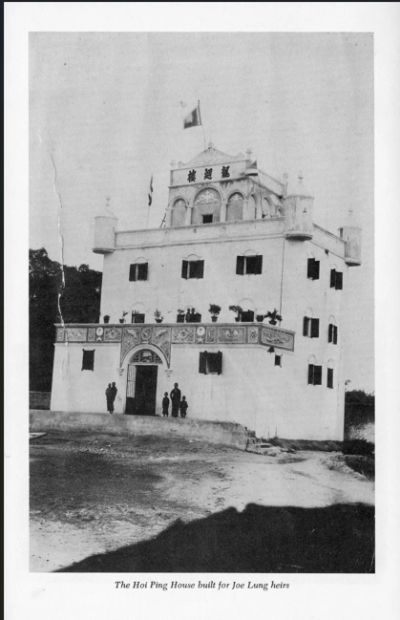
Long Hui Lou just completed in 1917 Kaiping, China
Buildings often preserve histories that written archives cannot fully capture. The Austin house represents an early Chinese presence in the American South—stories that are rarely recorded in mainstream urban histories and are vital to understanding Chinese American history. Long Hui Lou, meanwhile, reflects a distinctive architectural tradition shaped by migration, remittances, and global exchange, highlighting the complexities of migration and property law. Together, these two structures form a transpacific archive of migration and family memory.
Contemporary Relevance
The Repetition of Law
More than a century after Joe Lung purchased property in Austin, debates surrounding foreign ownership of land resurfaced in Texas political discourse. In 2023, proposed legislation sought to restrict property ownership by citizens of certain countries, including China. For many Asian American communities in Texas, the proposal echoed earlier legal restrictions placed on immigrants during the late nineteenth and early twentieth centuries. Historical research into figures such as Joe Lung reveals how questions of citizenship, belonging, and property rights continue to shape American public life.
Oral History Research
AAACI is currently conducting oral history interviews with descendants connected to the Lung family and related migration networks. These interviews document:
• family migration stories between Guangdong and Texas
• memories of Long Hui Lou and the ancestral village
• experiences of Chinese American communities in Texas
• reflections on identity across generations
These recordings will become part of the AAACI Community Archive.
Documentary Research
From Homeland to Hometown
This dossier forms part of the research foundation for the documentary project: From Homeland to Hometown. The film explores how archival research, family memory, and architecture can illuminate overlooked chapters of Chinese American history. The story of Joe Lung and Long Hui Lou serves as one of the film’s central narrative threads.
Archival Materials
Research materials related to this dossier include:
• property records in Austin, Texas
• family photographs and documents
• architectural documentation of Long Hui Lou
• oral history interviews with descendants
• historical research on Chinese migration in Texas
These materials are currently being compiled within the AAACI Community Archive Project.
Research Credits
Research and documentation by:
Xuhua Zhan
June Xu
Lok Yiu
Asian American Art & Culture Initiative (AAACI)
Citation:
Asian American Art & Culture Initiative (AAACI). Joe Lung Dossier. Research by Xuhua Zhan, June Xu, and Lok Yiu, 2026.
Research areas include:
• Asian American migration history
• community archives
• oral history documentation
• documentary film research
• public humanities
This project is developed in collaboration with the Austin Chinese American Network, with support from the City of Austin Heritage Grant, recognizing the importance of preserving Chinese American history in Austin.
Asian American Art & Culture Initiative
We use cookies to analyze website traffic and optimize your website experience. By accepting our use of cookies, your data will be aggregated with all other user data.